

FJT Logistics News Brief: April 2026
Dear Partners & Friends,
Today’s disruptions are no longer temporary, they reflect a broader shift toward structural instability across global supply chains.
At FJT, we rely on data to maintain control in this environment, with the following insights drawn from our operational performance over the past 60 days.
The Macro View | Global Trends
Global shipping is becoming more complex and less predictable.
- Transit Volatility
Mediterranean → Australia lanes have increased by approximately 40% vs historical baselines - Operational Delays
Global sea freight delays are currently averaging 9.8 days - Capacity Shifts
Rerouting strategies are now the primary driver of arrival consistency
Port to Port Performance Insights
Mediterranean Corridor (Europe - Australia)
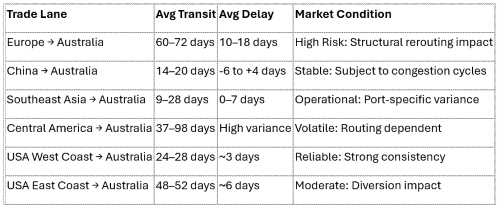
Across the Mediterranean corridor to Australia, transit expectations have shifted with rerouting via the Cape of Good Hope resetting what’s considered “normal”, with a minimum 14-day contingency buffer.
- La Spezia → Sydney/Melbourne
49–59 days | Delays up to 19 days - Napoli → Sydney
~71 days | Delays ~17 days
Piraeus → Melbourne
~72 days | Delays ~14.5 days
Asia Corridor (China & Southeast Asia - Australia)
Across Asia – Australia lanes, stability is holding, performance is increasingly shaped by how efficiently transshipment hubs are operating, port selection is key and routing via less congested hubs to help maintain schedule reliability.
- Shanghai → Sydney
~14 days | Best-performing lane - Tanjung Pelepas → Melbourne
~13 days | High reliability (sub-1 day delay) - Port Klang → Fremantle
~9 days | Strong performance for WA-bound cargo
Singapore → Adelaide
~23 days | Delays averaging ~7 days due to congestion
Central America Spotlight
Across the Americas to Australia, this region has the greatest level of variability across all trade lanes, and now equires a far more active routing strategy and tighter carrier management to ensure reliable outcomes.
- Buenaventura → Melbourne
32 days (express) → 66 days (standard) → up to 98 days (outliers) - Puerto Cortes → Melbourne
~37 days | Currently arriving 2.7 days ahead of schedule
Interstate Rail Integrations
We’re seeing a growing shift toward interstate rail integration, particularly for 20’ and 40’ container movements, for more reliable and efficient inland transport options.
Rail is helping reduce exposure to road congestion and fuel costs, while also offering significant environmental benefits, producing up to 16 times less CO₂ emissions compared to traditional road transport.
National Warehousing Model
Our multi-state warehousing footprint allows us:
- Decentralise inventory positioning
- Reduced reliance on single shipment flows
- Protection of last-mile delivery performance
This helps protect last-mile performance so international delays don’t disrupt local delivery.
Forward Planning
In the current environment, forward planning has become more critical than ever.
- Secure sea freight space 4–6 weeks in advance
- Apply a minimum 14-day buffer for European cargo
- Airfreight rates now valid for 24–48 hours only
Looking at the bigger picture, success in today’s logistics landscape is no longer defined by how fast cargo moves, but by the level of certainty, control, and execution behind each shipment.
Thank you for your continued trust and partnership
Regards,
FJT Logistics
Regional Performance Overview (Last 60 days)
CUSTOMS NOTICES
Export Cost Recovery Implementation Statement (CRIS) 2026-27
The Australian Government has delayed full cost recovery for export regulatory arrangements by 12 months to 1 July 2027, providing temporary relief to exporters facing ongoing disruptions.
What This Means for You
✔ Temporary Relief for Industry
✔ Pricing Stability for 2026–27
✔ Legislative Timeline Unchanged
[email protected]
Import Industry Advice - GREECE
Following a reported foot-and-mouth disease (FMD) outbreak, Greece is no longer FMD-free from 15 February 2026, affecting importers bringing FMD-susceptible goods into Australia.
Goods produced before 15 February 2026 may be allowed entry with evidence, while those produced after may be denied entry, re-exported, or destroyed, also being assessed on a case by case basis.
To manage the biosecurity risk to Australia, Greece has been removed from the FMD-free country list and the List of countries for natural casings derived from bovine, caprine, ovine or porcine animals.
